

Rosa Decarolis
Lecturer in Drawing and History of Art
testiCritici.notaTraduzione
Davide Cristofaro, a young “Talent” from Martina Franca, a town in the beautiful Valle d’Itria: and this in an age such as ours, in which the Muses play hide-and-seek and definitions crumble like snow in spring, so that terminology dissolves into mists of ambiguity and “painting” can also mean a mixed-media depiction of compelling peculiarity, or indeed any other digression, telluric or meteoric, in the equivocal Empyrean of chromaticity and plasticity. Cristofaro, instead, attests that he is a painter (batik prints, serti, oils, pastels, collages, temperas, mixed-technique paintings, portraits, charcoals). He calls himself as witness, through his own works, which thereby become certifying signs, corroborations and even documentary research. In his works he offers, without any exhibitionism, an ideographic cross-section of his own identity, a vertical-section drawing of his vocation and evolution: his academic attendance as much as his studies in style, his avant-garde experiences as much as the skills acquired in graphic art, of which he has retained the exact, incisive taste, almost a preferential option for “volume”, at once measure and corroboration in mixed-media art. The matter he proposes is not only oil colour on canvas, but also the presence of other humble material. From it he draws human figures, silhouettes, heads, landscapes, in which the bodily reference transcends, in the invention of creativity, the purely anthropomorphic datum.
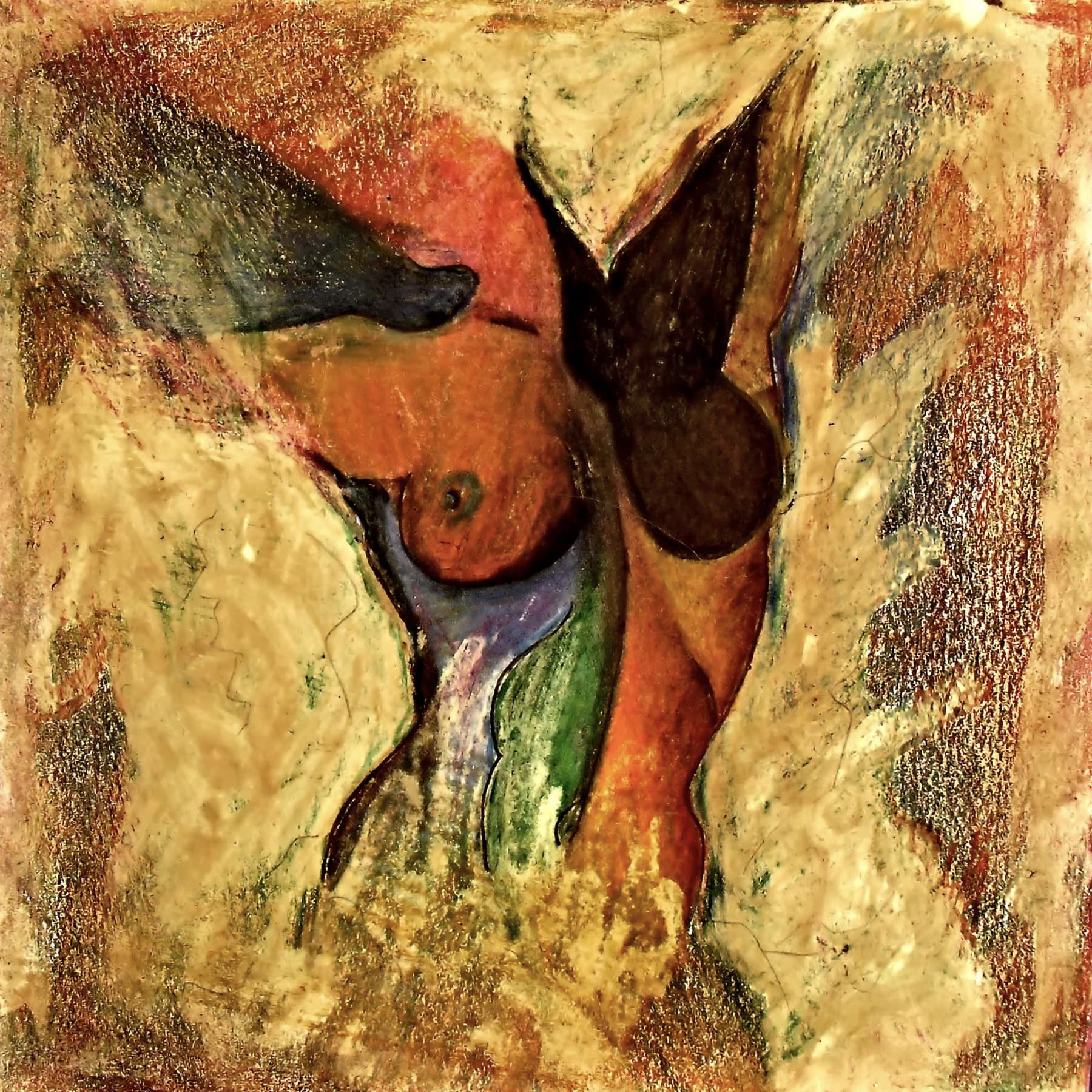
From this he derives complex compositional elements, works of art in their own right: now geometric, spaced out, balancing arduous equilibria of “voids” and “solids”, now flat, marked by obscure hieroglyphs, by allusive symbols. In this light the faces, the inert female nudes, are set against the frames (from which endogenous forces rise), as well as against the spatial structures. Between the individual figures and the compositions a relationship is thus established, one not confined to a complementarity of style, but which sets itself the goal of a “contemporaneity” of action and of conception which, once fully achieved, would allow Davide Cristofaro to assuage that yearning for a synthesis of form and content in which his young and promising artist’s sensibility is struggling.


